Inside the Patch — a TouchDesigner workflow session
RNA Studio, Lisbon
Oct 6 / 2026 · by Luka Papashvili
free workshop - Register here luma.com/tkeshifestival
Powered by TouchDesigner
A session with Skywalker Visuals on how a real-time visual practice actually works, from the inside. Instead of teaching one technique step by step, I open my own project files and walk through the workflows I have built across my TouchDesigner career: how a graphic and product design background turned into motion work, how motion work turned into live audio-reactive systems, and how those systems get built, performed and delivered on real commissions.
Participants leave with a clear picture of a working real-time practice end to end, from first idea to a system running live on a stage.
About the artist
Luka Papashvili is a Georgian multimedia artist working in generative art, live audiovisual performance and interactive installation. He began in graphic and product design, moved through motion design, and now works primarily in TouchDesigner, building real-time systems where sound, movement and presence drive the image as it is generated rather than played back.
Skywalker Visuals is his audio-reactive project, performed across clubs, festivals and stages in Georgia and internationally, with live visual collaborations alongside artists including Boston 168, Nico Moreno, Monolink, The Blaze, Phase Fatale, Vitalic, Octave One and Francis Mercier. His work spans LED stage visuals, projection mapping and interactive installations driven by depth cameras, MIDI, AI tracking and AR/XR media.
He is Visual Director of TKESHI festival, where since 2023 he has led the visual programme and its educational strand. He also created SYNC // STREAMS, a curated series of collaborative live audiovisual sets, teaches TouchDesigner workshops, and publishes custom TouchDesigner assets publicly through Derivative.
skywalker.vision · instagram.com/skywalker._.visuals
What participants will see and learn
The path into real-time. How a background in graphic led through motion design into TouchDesigner, and what carried over. Useful context for anyone arriving from a design or animation practice rather than from code.
Selected project files, opened live. I go into the actual patches behind finished work and explain the structure, not just the result:
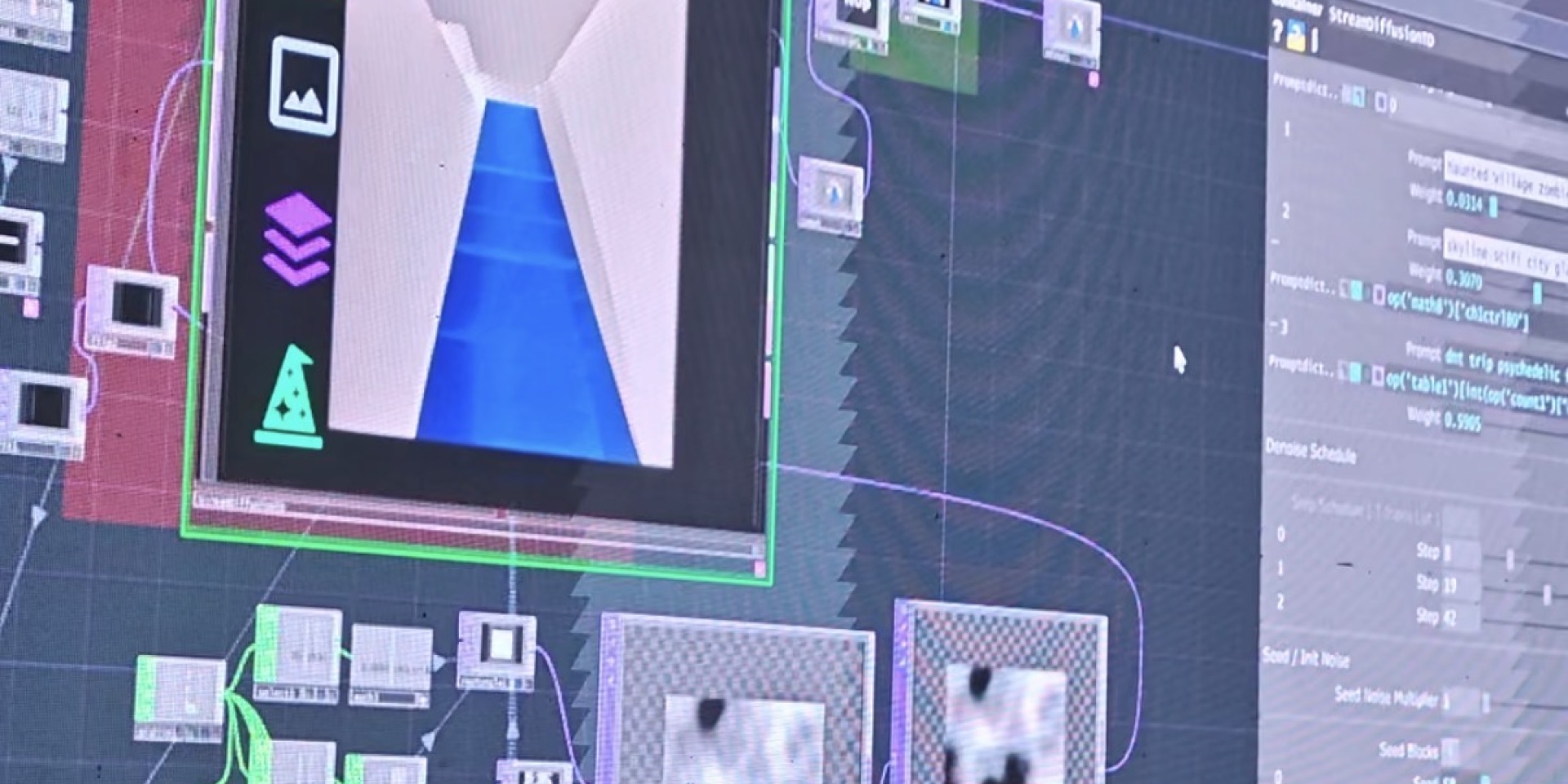
- AI + TouchDesigner workflow — where generated material enters a real-time chain, and how it is controlled rather than left to chance.
- Commercial projects — delivered work for clients including H&M (Dubai), Volvo, Audi, GTI Holding and Lazulite (Dubai). What changes when a system has to be handed to a client and run reliably on site, day after day.
- Animated audiovisual workflow — custom keyframed animation built directly in TouchDesigner, for visuals that stay precise and repeatable while keeping the system efficient.
- My VJ setup and audiovisual streams — the rig I perform with, how it is organised and why it is built that way, shown alongside recent stream work made with it.
How the content was actually made. For selected pieces I trace the route from the first idea to the finished output: what generated the image, what drove it, what was fixed in the moment.
Tools and custom effects. I share components I have built and use in performance, including my audio analysis tool — how the signal is split, shaped and mapped so visuals feel musical instead of twitchy.
Interactivity, in brief. Depth cameras, presence and movement as input, and how audience participation becomes part of the system. Covered through demonstration and examples from installation work.
Performing a system. MIDI control alongside audio reactivity, and what separates a patch that reacts from one you can actually play.
Final outcome
Participants leave with a clear understanding of how a real-time audio-reactive system is built, controlled and performed, and with the audio analysis tool and example files to keep working with. Beyond the files, they leave with a method: how live input becomes image, and what it takes to bring that from a laptop to a stage.
RNA Studio, Lisbon
Oct 5,, 2026 · @Someone
Powered by TouchDesigner
Inside the Patch — a TouchDesigner workflow session with Skywalker Visuals.This workshop shows how a real-time visual practice actually works, from the inside. Instead of teaching one technique step by step, I open my own project files and walk through the workflows I have built across my TouchDesigner career: how a graphic and product design background turned into motion work, how motion work turned into live audio-reactive systems, and how those systems get built, performed and delivered on real commissions.
Projects are opened on screen, taken apart, and explained through the decisions behind them — why this structure, what broke the first time, what makes a patch survive being performed in front of an audience. Alongside the work I share tools and custom effects I use every time I play, including my audio analysis setup.
Participants leave with a clear picture of a working real-time practice end to end, from first idea to a system running live on a stage.
What participants will see and learn
The path into real-time. How a background in graphic and product design led through motion design into TouchDesigner, and what carried over. Useful context for anyone arriving from a design or animation practice rather than from code.
Selected project files, opened live. I go into the actual patches behind finished work and explain the structure, not just the result:
• AI + TouchDesigner workflow — where generated material enters a real-time chain, and how it is controlled rather than left to chance.
• Lazulite (Dubai) projects — commissioned work, and what changes when a system has to be delivered to a client and run reliably on site.
• My custom VJ setup — the rig I perform with, how it is organised, and why it is built the way it is.
• Recent audiovisual streams — work made with that setup, shown alongside the files that produced it.
How the content was actually made. For selected pieces I trace the route from the first idea to the finished output: what generated the image, what drove it, what was fixed in the moment.
Tools and custom effects. I share components I have built and use in performance, including my audio analysis tool — how the signal is split, shaped and mapped so visuals feel musical instead of twitchy.
Interactivity, in brief. Depth cameras, presence and movement as input, and how audience participation becomes part of the system. Covered through demonstration and examples from installation work.
Performing a system. MIDI control alongside audio reactivity, and what separates a patch that reacts from one you can actually play.
outcome and practical details
Final outcome. Participants leave with a clear understanding of how a real-time audio-reactive system is built, controlled and performed, and with the audio analysis tool and example files to keep working with. Beyond the files, they leave with a method: how live input becomes image, and what it takes to bring that from a laptop to a stage.
Luka Papashvili is a Georgian multimedia artist working in generative art, live audiovisual performance and interactive installation. He began in graphic and product design, moved through motion design, and now works primarily in TouchDesigner building real-time systems where sound, movement and presence drive the image as it is generated rather than played back.
Skywalker Visuals is his audio-reactive project, performed across clubs, festivals and stages in Georgia and internationally, with live visual collaborations alongside artists including Boston 168, Nico Moreno, Monolink, HVOB, Phase Fatale, Vitalic, Octave One and GusGus. His work spans LED stage visuals, chat give me for tkeshi.com poleshed